

More machine than man
That's not exactly the best case scenario

It is finally February. And I just realized this is the first classical music news round up of 2025!
Sign of the times
What a pair of headlines to see in my classical music news web search.
Last October the Munich Symphony Orchestra performed a work co-composed by Jakob Haas, Adrian Seiber, and Google Gemini API. So, an AI-collaborative classical work - though they described it as “more metal than Mozart.” How’s that for a metaphor?

Meanwhile Edmond Dédé's opera Morgiane had its premiere in St. Louis Cathedral in New Orleans in late January - 138 years after its composition. It was a homecoming for the composer, who was baptized in that same church. The New Orleans performance was a preview of upcoming staged premieres in DC, Maryland, and New York. There’s great information in this coverage, including a reminder of New Orleans’s history as an opera destination.
But let’s think this through. Sure there’s room for a bit of everything in this 800-ish year old genre we call classical music. However, what does it say about us when we give space to computer generated work before the work of a composer, you know, lived?
It boggles my mind sometimes to consider how we use our AI capabilities. The line is always that they can be “a tool for creativity.” But when it’s generating the ideas? Like in the case of Google’s efforts the title? Surely there’s a better task to give away. For example, could AI not have helped with the massive years-long effort it took a group of artists to piece back together the score of Morgiane?
I’ve frequently said about our business that programming is budgeting, and budgeting is an exercise in priorities. But how we use technology is also a terrific demonstration of our priorities. We want to be unlimited in our creativity. So we’ve applied AI to the act of writing. But what non-creative work could it take off our plate instead? Wouldn’t that too then be a “tool for creativity?” What hidden repertoire gems could AI help find and reassemble?
The senior program manager at Google Arts & Culture, Simon Rein, said, “What made this project special to me was the emphasis on how AI can support creativity and human connection…” The reality is that in this 800-ish year old genre we call classical music, there’s room for both the new and the old. If we are to coexist with AI, let’s consider that priority: bringing people together. But when we do that, let’s be sure we catch those we missed along the way.
Hans Zimmer in Saudi Arabia
Speaking of giving composition tasks away:
Apparently composer Hans Zimmer - the guy from The Lion King, Pirates of the Caribbean, Dune, Interstellar, and many, many more, is in talks with the General Entertainment Authority of Saudi Arabia for multiple projects - one of which is a reorchestration of the Saudi national anthem.
The country had banned cinemas for 35 years, only reopening them in 2018. So it’s no surprise that they’re seeking big talent to bring some life into the growing industry. Bringing in an American composer makes perfect sense for film. But for the national anthem?

Music in Cardiff
In order to deal with a £31.2m budget deficit, the University of Cardiff announced it was going to cut several academic programs, including music. That particular program, established in 1883, represents part of a cut of around 7% of the Welsh university’s workforce. Proposed cuts also include the school’s nursing program.
The music school is on the chopping block because of a drop in revenue due to a dwindling number of international students participating in its program. This echoes a little-discussed trend that I have seen in other music schools, especially here in the USA. Schools often the high number of students from around the globe as emblematic of their diversity and desirability. But there is another benefit that schools don’t often mention.

International students pay a higher fee. At the University of Cardiff, it’s more than twice the tuition for domestic students. It’s for good reason relating to families supporting the university through taxes, but it’s there. A university benefits financially more from international students than local.
While there are over a million international students in the USA this year, this number might take a turn via the current administration’s policy choices.
Chopin List
Jesse Eisenberg’s new film is scored with the music of Frederic Chopin.
Eisenberg was apparently on a Chopin kick while writing the script, so he stuck with it for the finished product. Eisenberg also shares Polish heritage with the pianist/composer.
It made me wonder: if I was going to choose an dead composer and score a film with their existing work, who would you select? I’d probably go with Shostakovich, but that would be an awfully dramatic film.
Lost Music
With Holocaust Remembrance Day last week, and the 80th anniversary of the liberation of Auschwitz, classical music, especially classical radio, took a look at some of the music that was actually composed in concentration camps. Works by Viktor Ullmann, Gideon Klein, Ilse Weber, Pavel Haas, and many more made their way on air that day.
“Our desire for culture was matched by our desire for life.” -Viktor Ullmann, who was later killed at Auschwitz after composing several works at Theresienstadt
I’ve never heard music making cited as a reason for holocaust denial before this year, but now I have, which was disturbing. I suppose some with radical ideas are feeling empowered at the moment. But it’s absolutely true that musicians who were put in these camps did perform and compose. A new film features musician Leo Geyer exploring the fragments that remain of some of the works composed there.
Roderick Williams
I enjoyed a recent interview with the British baritone. Especially when he talked about not being too precious with his voice. The pull quote about not eating peanuts before a show is funny, but even better is, “First thing every morning I wake up, clear my throat and see what’s what…”
The ultimate “keep calm and carry on” for a singer. Must be nice.
But the fearlessness continued when he was asked about the typical “death of classical music” idea. And even his own “death playlist.”
Read the interview here. And listen to the man SING below.
And some “new” artists
It’s not classical music news, but if you missed it, you should go back and watch the New Artists performances from this year’s Grammy Awards. Much of the evening was a love letter to LA and Hollywood, with Sabrina Carpenter and Chappel Roan in solo sets on theme - one glossy and one gritty, both excellently done. But the montage of hits from the other nominees was a highlight.

Roan and Carpenter got to accept their individual awards after performing. As impressive as the turnaround for that is, Doechii had the bigger task. Going from openly moved and emotional while accepting Best Rap album, to precise and athletic choreography and lightning fast lyrics in her performance of Catfish and Denial is a River was one of the most “showbiz” things I’ve ever seen.
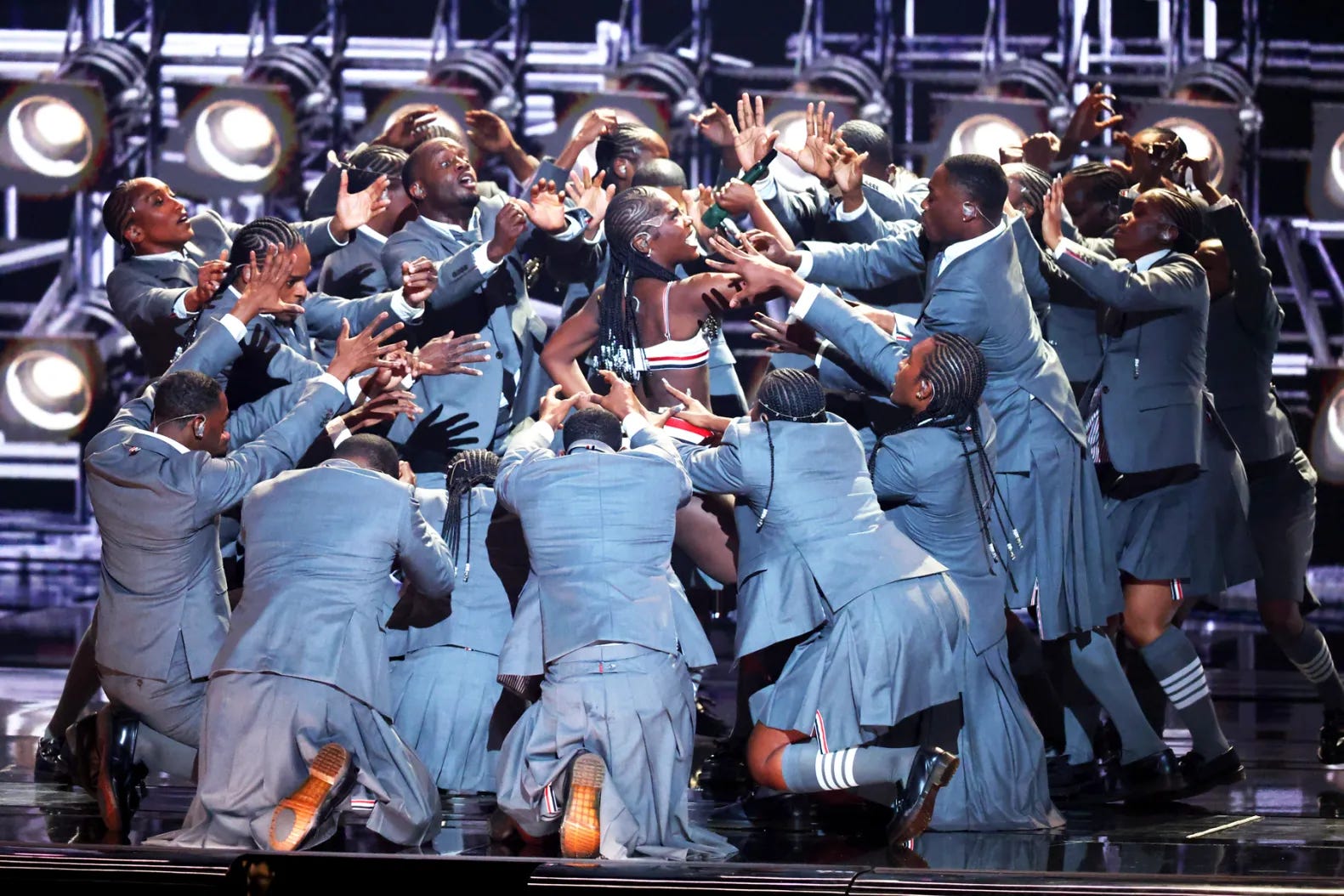
Look them up if you missed them.
-Colleen
Last Tuesday’s newsletter is the most-read on this substack by far. Thank you to all of you who shared it, and welcome to new subscribers. A share is the BEST way to support the newsletter, so please forward it along to anyone who you think would enjoy it.